


A metal sign stand is a steel frame that holds a printed board upright with nothing behind it. Distributors, sign shops and contractors order three formats: a folding A-frame for pavements, an H-frame for lawns, and a 13-inch wire stake for 4 mm corrugated boards. What you stock decides what comes back as a reorder.
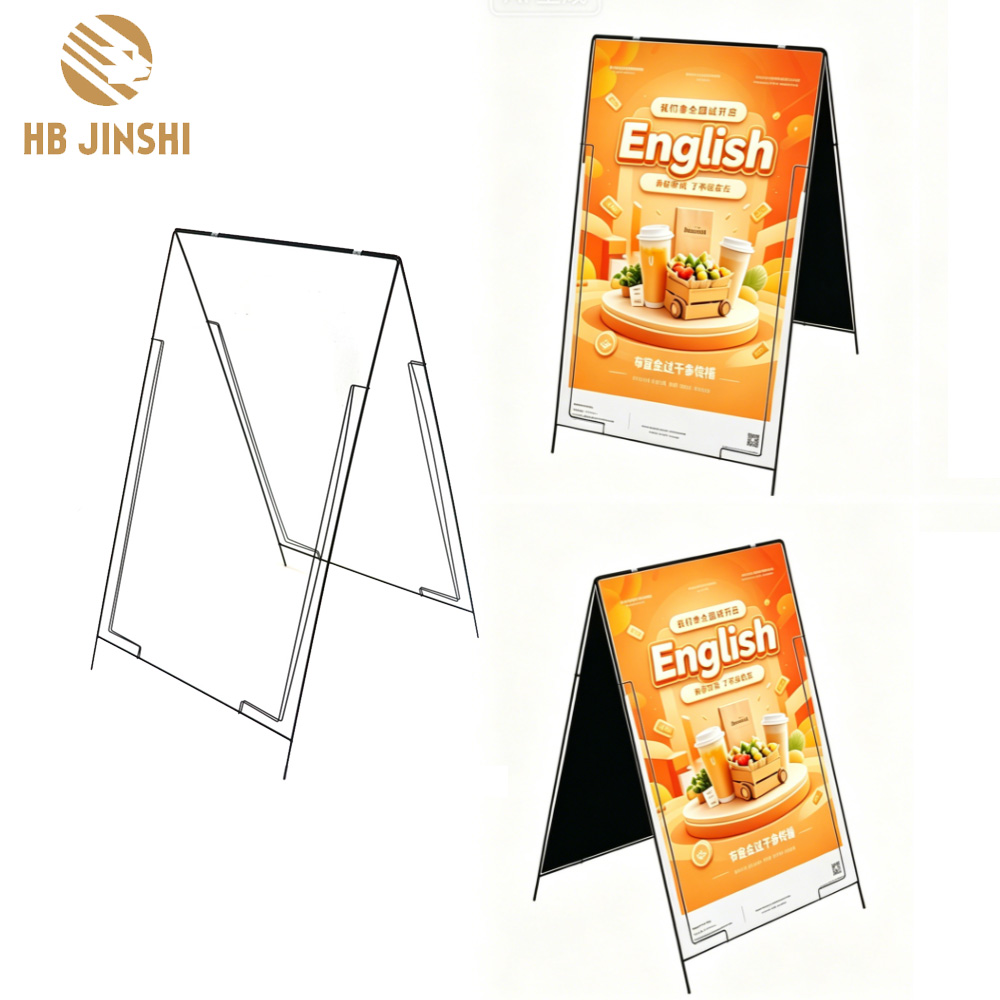
Three shapes, three jobs, and who reorders which
Nine enquiries out of ten arrive as “sign stand, please quote” with nothing else. These formats are not variations of one product: different boards, ground, and failure points.
| Format | Board it takes | How it stands | Ground | Finish | Who reorders it |
|---|---|---|---|---|---|
| A-frame, wire insert | 60 x 102 cm poster slid into the frame | Folds flat; two legs plus bottom rail | Pavement, shop floor, gravel | Black powder coat | Garden centres, cafés, retail chains buying in pairs |
| H-frame yard stand | 115 x 93.5 cm or 105 x 93 cm rigid board | Two stake legs driven into soil | Lawn, verge, field edge | Powder coat or galvanized | Estate agencies, campaign suppliers, event contractors |
| Wire yard stake | 4 mm corrugated board, 13-inch stem | Single or H wire pushed into turf | Soft turf, not paving | Hot-dip galvanized | Sign shops, print brokers, promo distributors |
Stock the format your customer already prints for. A sign shop running 4 mm corrugated board will not switch to A-frames because your price is sharp. It will add the stake to an order it is placing anyway. That is what turns a first order into a monthly one.
A-frame sign stands: the wire insert does the work
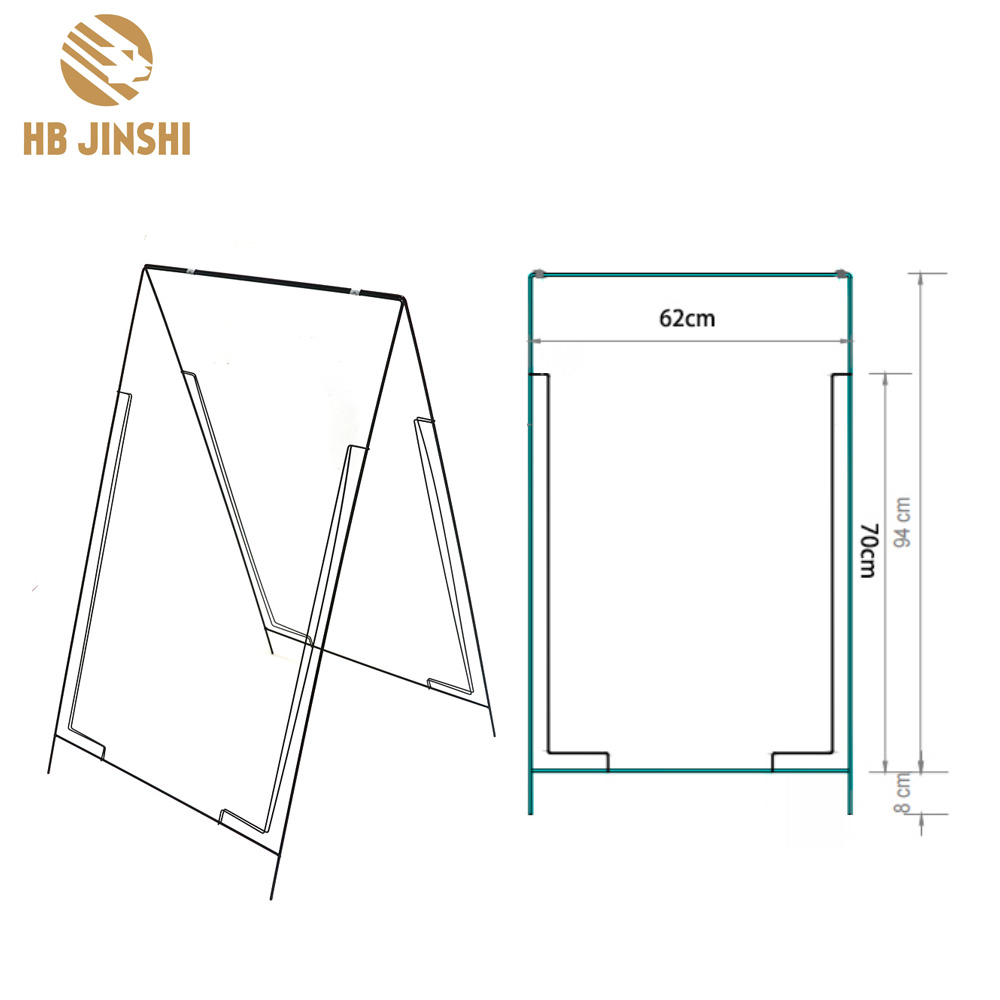
A wire-insert A-frame sign stand is a folding steel holder in which the poster is trapped between two wire frames instead of clipped to a solid panel. On our 60 x 102 cm model the outer frame runs 5.0 mm wire and the slot wire 2.8 mm, which is why the top corners still line up after a summer on hot pavement.
Two faces means two posters, which is one upsell your customer will actually pay for.
The slot takes a poster around 2 to 3 mm; a 5 mm foamed PVC panel will not slide in, and that becomes a return. Confirm thickness with your printer, and quote the poster size rather than the frame size in a catalogue photo.
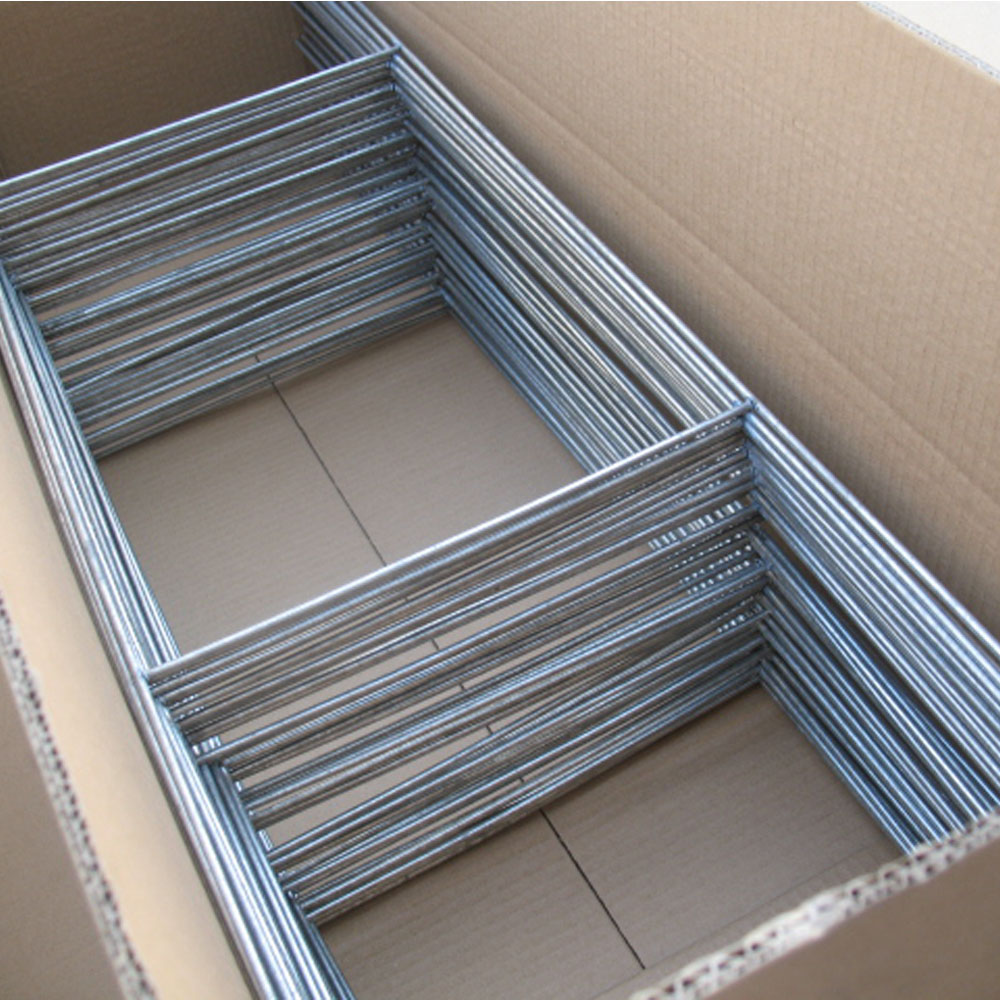
Shipping is where the A-frame earns its keep. It folds flat, ten per carton, bagged individually and alternated front to back so no leg presses into the next frame’s coating. Ask for the CBM per carton early: a carton 4 cm too deep wastes space on every order. The frame also tips in a gust once the poster acts as a sail, so we advise a sand bag on the bottom rail for exposed corners.
In our workshop we fold one frame in every ten and check the hinge rivet by hand. A stiff hinge sells, then returns as a complaint eight weeks later.
Send your poster size and annual volume to jinshi@wiremeshsupplier.com and we will confirm slot width, carton CBM and price breaks in one reply.
H-frame yard sign stands: what the 115 x 93.5 cm format changes
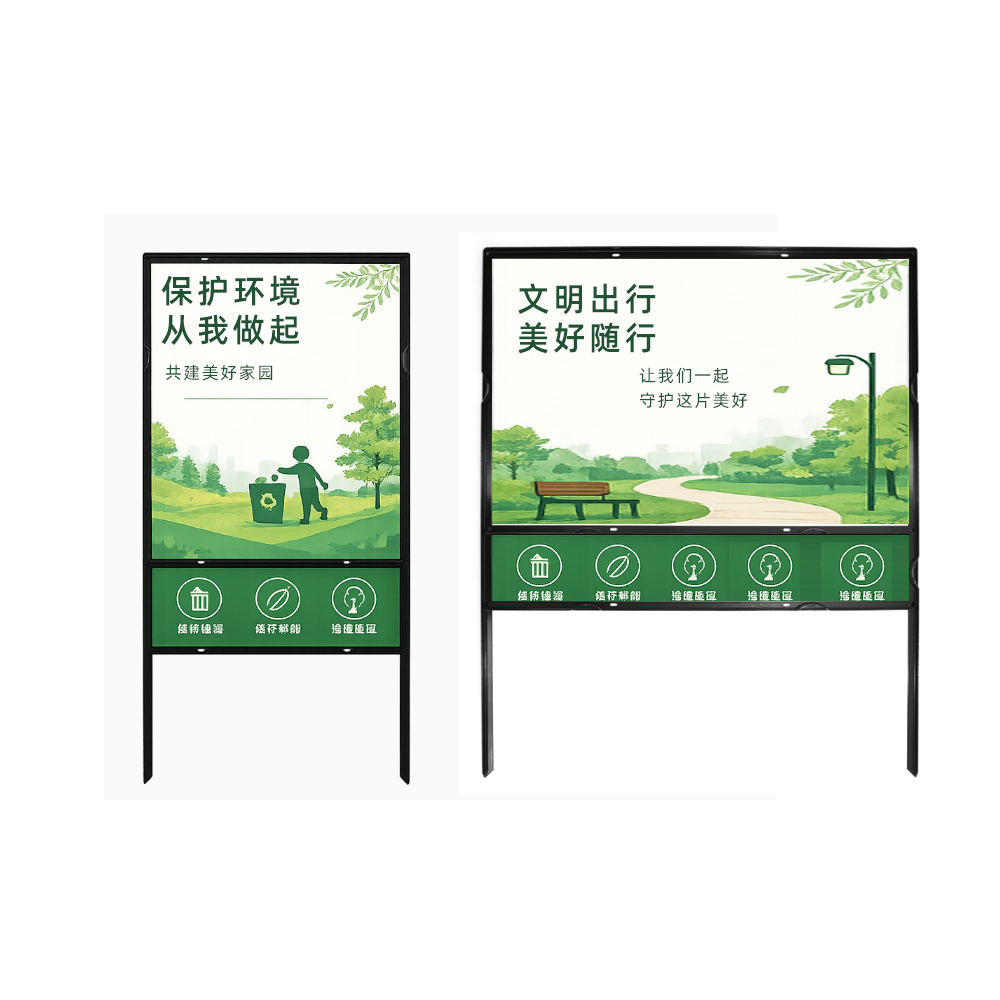
An H-frame yard sign stand is a rigid steel holder with two vertical legs that enter the ground and a rectangular frame carrying one board. Ours takes a 115 x 93.5 cm board (45.28 x 36.81 in), with a 105 x 93 cm option for buyers already printing to that size.
Estate agencies reorder it because the board sits square and reads from 30 m. The panel stops fluttering and survives a mower pass.
Two things keep it upright. Leg length: 20 cm in soft lawn is not enough after rain, and the unit leans by noon. Board material: 4 mm corrugated flexes in crosswind, so 6 mm or an aluminium composite face is safer at 115 cm.
Contract work adds a third question. A housing development needs the same frame in three deliveries, and the second batch has to match the first on a street where both are visible. Lock wire diameter, colour code and leg length on the drawing, then quote repeats against it; we keep the approved sample and setting sheet for that reason.
Hard ground changes the plan. The leg will not enter compacted gravel, asphalt or frozen soil, and hammering bends it at the weld. Bolt on a base plate with our brackets and base fittings, or set the legs into ground screws.
Wire yard sign stakes: the 13-inch workhorse
A wire yard sign stake is a galvanized steel wire frame, typically 13 inches tall, that grips a corrugated sign by its flutes and pushes into turf. Ours runs 3.4 mm and 3.75 mm wire, hot-dip galvanized, sized for 4 mm board, near 1 kg packed at 76 x 25 x 1 cm.
For a distributor this is the basket builder: it ships flat, costs less per sign, and joins an order that already exists.
It also draws more complaints, because buyers use it on the wrong ground. Dry summer lawn holds a 4 mm board. Loose mulch puts the same stake on its side before the weekend, and the complaint lands on the reseller.
Order quantity starts at 100 pieces, logo printing at 5,000, custom packaging at 1,000. Production runs about 10 days at these volumes and stretches above 50,000, which we would rather say at quotation than after the deposit.
Testing one stake against your own board beats reading a spec sheet. Ask for a sample with your board thickness written on the bag.
Finish, packing and landed cost
Powder coat or hot-dip galvanized
Both finishes work. The gap shows up in year three, when your customer decides whether to reorder.
| Finish | What it is | Where it holds | Where it struggles | Cost position |
|---|---|---|---|---|
| Polyester powder coat | Electrostatic powder, oven cured | Shop fronts, indoor displays, dry climates | Chipped edges on gravel; salt air | Mid |
| Hot-dip galvanized | Immersion in molten zinc, ISO 1461 | Wet ground, rural sites, roadside | Reads industrial grey rather than black | Low to mid |
| Galvanized then powder coated | Zinc layer plus powder topcoat | Coastal, heavy daily handling | Highest unit cost | High |
Colour is a purchasing decision. Powder coat is matched to a RAL or Pantone reference, with a code or physical sample approved before production, because “black” covers four different blacks and just one matches the shopfront.
Powder coat scratches when a frame is dragged across concrete. That is what powder does, not a defect to argue about. Daily handling favours galvanizing; a shopfront favours black powder coat.
Field experience rather than lab sheets: 3 to 5 years for powder coat on a city street, 8 to 12 for hot-dip galvanized. Coastal air shortens both.
What actually moves your landed cost
Four levers, in the order they usually matter.
- Volume break. 100, 1,000 and 5,000 pieces sit at different price points. Ask for all three tiers, and whether formats can be pooled to reach the next one.
- Wire diameter. Dropping the A-frame from 5.0 mm to 4.5 mm saves material and shows as wobble at the top corners. It is the first place a cheap quote hides a difference.
- Packing. Ten frames per carton, alternated front to back, individually bagged. Skip the alternation and you get rub marks you cannot sell at full price.
- Customisation. Logo plates, printed cartons and barcode labels each carry a minimum and move the delivery date. Put them in the first email, not the third.
Landed cost is arithmetic. Frames ship flat, so carton size and CBM decide how many fit. A quotation without a carton dimension asks you to guess your own margin.
What we check before the container leaves
Hebei Jinshi Industrial Metal Co., Ltd. (HB Jinshi) has been making wire and steel in Hebei since May 2008, and the sign frames run on the same lines as our fencing work. Some importers treat “China supplier” as one risk. The risk sits in three places, and all three can be checked.
Weld and hinge. We pull a frame from each batch, open and close it, and look for spatter inside the fold line. A hinge that catches wears the coating through in weeks.
Coating thickness. A magnetic gauge reads the powder layer. Thin spots show up first in the inside corners, which is also where rust begins.
Certificate numbers. ISO9001, ISO14001, SGS, CE and BSCI certificates are worth what the number is worth. Ask for the number and the issuing body, then verify both. We send them with the quotation.
Third-party inspection at our works is fine, and packed-carton photos go out before the container is sealed. If your customer’s deadline is fixed, book the inspection early; it is the step that moves last.
The RFQ that gets a usable quote in one reply
Most price comparisons fail before they start, because two suppliers quote against two different drawings. Six lines fix that.
- Format and board size. “A-frame, 60 x 102 cm poster, 3 mm laminated” says more than “sign stand”.
- Quantity per format and per colour. Mixed pallets are workable; the tier is set by pieces per format line.
- Finish and colour reference. A RAL or Pantone number, or a sample posted to us.
- Logo and packaging. Frame plate, carton print, barcode label for resale. Each has a minimum.
- Destination port and Incoterm. FOB and CIF price differently; duty sits on your side either way.
- The date the goods must be on a shelf. Not the ship date. We work back from it and say if it is realistic.
What comes back: a drawing with wire diameters and slot width, carton dimensions with CBM, price per tier, sample and production lead times.
If one of those is missing, ask before you compare prices. A number without a carton size is not a price.
FAQ
What is the minimum order, and can I mix formats in one container? Wire stakes start at 100 pieces; A-frames and H-frames are quoted per format. Mixed containers are normal practice, each line at its own tier.
Can you match our brand colour and print our logo? Powder coat is matched to a RAL or Pantone reference, sample approved before production. Logo plates start at 5,000 pieces, custom cartons at 1,000.
What board thickness fits a wire-insert A-frame? 2 to 3 mm on our 60 x 102 cm frame. Laminated paper and thin PVC slide in; 5 mm foamed PVC does not.
How do you keep a repeat order identical to the first batch? The approved sample, wire diameters, colour code and leg length stay on file with the setting sheet. Repeats run against that record, not a fresh drawing.
What is the lead time on a first order versus a repeat? About 10 days in production at standard volumes, longer above 50,000 pieces. Custom colours and packaging add time; the date is confirmed in writing before the deposit.
What documents and inspection options come with a shipment? Invoice, packing list and bill of lading, plus the certificate of origin your broker asks for. Third-party inspection is welcome.
Post time: Nov-19-2026