


Metal garden edging problems almost always trace back to the specification rather than to the steel. The six that reach us most often: a border asked to hold back soil, stakes missing from the carton, a strip that reads shorter once buried, sharp edges, early rust, and joints that open. Each one has a fix that belongs on the order sheet.
Every item on that list is cheaper to solve at the quotation stage than on site. Here is what each problem looks like, and what to write into the order.
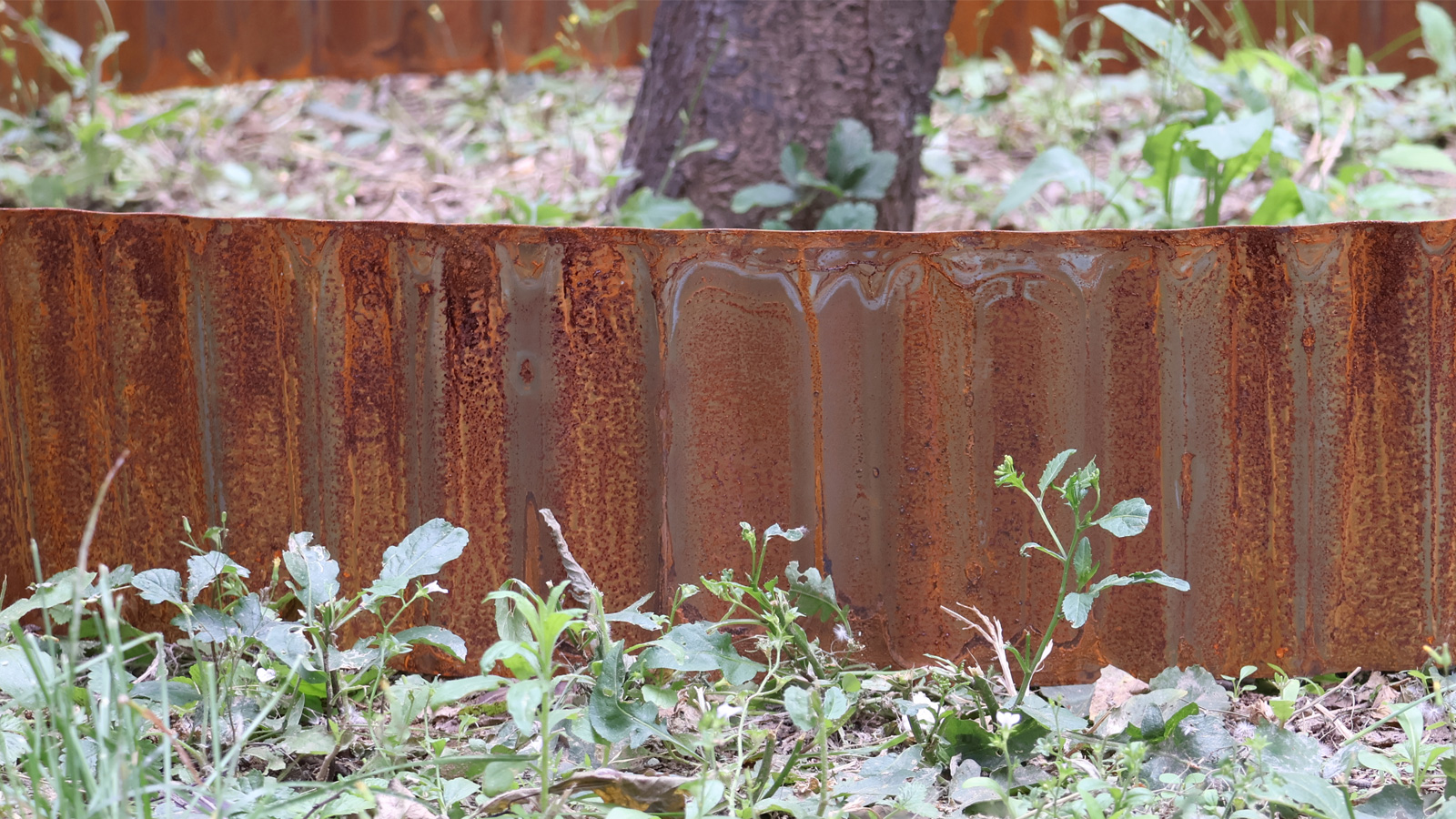
Problem 1: The border was asked to hold back soil
Metal garden edging is a thin steel strip that separates two surfaces and keeps a mown edge clean, which means it resists a mower wheel, a grass edge and mulch creep. It does not carry soil load.
A retaining wall is a structure that carries lateral soil pressure, and it is a different product class with different thickness, footing and depth. Confusing the two is the most expensive mistake in this category, because the strip fails after the site is finished rather than during installation.
| What a 15cm edging strip handles well | What it cannot do |
|---|---|
| A level change of a few centimetres between lawn and bed | Hold back a raised level much taller than the strip |
| Mulch and light gravel creep | Carry soil pressure on a sloping bed |
| A mown edge along a path or drive | Act as a footing for paving |
| A clean gravel edge line | Stop a bank from moving |
Where the drawing shows real soil pressure, the honest answer is a different product. Gabion baskets retain soil and drain at the same time, and where a raised frame needs structure rather than a border, ground screws carry the load.
Fix in the order: write down the maximum level change the strip has to hold. If that number is more than a few centimetres, the item being ordered is not the item needed.
Problem 2: The stakes were not in the carton
This one arrives as a complaint rather than a question. A coil of edging and a box of stakes are two line items, and retail packs differ on whether the stake travels inside the carton. Buyers who assume otherwise end up with a border that leans after the first season.
Punched holes run down the lower flange at a spacing that is usually 20–25cm, and the stake spacing that holds a border in most soils is 60–80cm. Those two numbers have to match the stake a customer can buy locally, which is why we ask for both before quoting. Order the stake in the same shipment from the edging accessories range and the carton arrives complete.
The alternative is the spiked variant, where a formed spike is part of the strip and no separate stake is needed. That version is asked for by name in some markets, and it removes the mismatch entirely.
Fix in the order: state whether stakes are included, the hole spacing, and the stake length. If your market expects a spiked product, say so at the quote stage rather than at the reorder.
Problem 3: The height did not match the picture
The strip is 15cm tall. The border a customer pictures is usually about half that height, because part of the strip goes into the ground.
| Strip height | Buried depth (typical) | Visible above grade |
|---|---|---|
| 10cm | 4–5cm | 5–6cm |
| 15cm | 5–7cm | 8–10cm |
| 20cm | 7–9cm | 11–13cm |
The working rule is to bury between one third and one half of the strip. Nothing should sit flush to the top lip, because a shallow trench over thin backfill is what lifts in the first hard frost. The 15cm x 5m galvanized edging roll is quoted with strip height and hole spacing on separate lines for exactly this reason.
Running grass adds a second layer to the question. Where a lawn spreads by runners rather than seed, the customer usually needs a deeper buried flange rather than a taller visible border, and those two requests lead to different products on the same page.
Problem 4: Sharp edges and a strip that bent during installation
Two complaints with the same root: the edge profile and the installation method.
The top edge is the part a hand touches, and it is worth specifying a folded, rounded lip instead of a square cut. A rolled top edge removes the sharp line, protects the mower deck when a wheel rides the border, and hides the cut end where two strips meet. It also happens to be a feature buyers search for by name, and it is the detail that separates two visually identical coils on a shelf.
Bending is an installation problem rather than a material one. A rubber mallet on the top edge, or a wooden block between hammer and steel, spreads the load. Dry, compacted or stony ground is where strips buckle, so we usually advise wetting the line a day beforehand and cutting the trench first instead of driving the strip through turf.
Gloves are not optional on bare-cut steel. A folded lip helps at the top edge; it does not replace protection at the cut ends.
Problem 5: It started to rust earlier than expected
Zinc coating protects steel by sacrificing itself, so the question is not whether the strip will corrode but how quickly. Four variables decide that: coating weight, soil acidity, salt exposure and abrasion.
Coating weight is the one that gets fixed at the order stage. On hot-dip zinc-coated strip under ASTM A653, the coating is written as a Z class, and Z275 means 275 g/m² across both faces. Two coils that look identical can carry different classes, and the difference shows up in year six rather than on arrival.
In the ground, expect a band rather than a promise. Service life is typically 10–20 years inland and shorter where salt air or abrasive gravel moves against the strip. A rust tone finish adds one more consideration: colour that drifts onto pale paving or render. Where that matters, keep the strip below the paving line and specify a plain galvanized or powder-coated finish instead.
Fix in the order: name the coating class, agree how it will be measured, and choose the finish by where the strip will sit rather than by the sample alone.
Problem 6: Joints, curves and mower damage
The last group concerns finish quality after installation rather than material.
Joints open when the ends of two strips are butted with nothing behind them, so place a stake within about 20cm of every joint. Tight curves kink when the lower flange is forced, so notch that flange every 10–15cm on radii under roughly a metre and bend in small increments.
Mower damage is a height question, not a metal question. Where a wheel rides the line every week, the border leans toward the lawn over a season. Lower the visible height slightly and add a stake at the point of contact rather than ordering thicker steel.
Where the border continues to a path or a bed entrance, keep the material family consistent: a gate in the same finish reads as one designed edge rather than two separate purchases.
Post time: Oct-16-2026